
Curtain closed.
NARRATOR
This is the story of Mary, a woman in search of her story. A woman who was, herself, a story. (Pause) Although no one had ever thought to tell her so.
Mary worked in a small room of a place she called home, where she was, according to the record of the company, Operator number one, one, three. Operator #113's job was simple: she sat at her desk and exchanged what they all called tokens with a box on her screen. The screen would receive her tokens and return something the company had called Value. This is what Mary did, and she did this every day, of every month, of every year. Although others might have found this work isolating — the quiet spinning of fans, the same 3 walls, the clitter clatter of keys, and tokens flowing through her like electricity from brain to screen (Pause, and then resume with earnest) Mary found in it something like peace. This exchange was reliable. This exchange produced value. This exchange made Mary content.
Curtain opens.
Mary is sat at a desk in the center of a 3-walled black box. The back of the box has 2 doors, each of the sides has 1 door, and the front wall is missing. Two stagehands, dressed in all black spandex with little colored dots resembling MOCAP suits are crouched beside the desk, ready to wheel the desk out.
And then, one day, something in the exchange changed. Mary had been at her desk for nearly an hour, watching a pinwheel turn when suddenly, the pinwheel disappeared. Her machine was not responding. She fed it tokens, nougats of herself. No value was returned. In all her years at the company, the exchange had never failed.
Something was very clearly wrong.
Mary stares at the screen. She tries again. She waits. She tries again.
And so, for the first time, Mary got up from her desk and stepped out of her home.
Mary walks to the back-right door and exits the blackbox. The stagehands wheel the desk and all scenery silently out the stage-left door, closing the door behind them.
Mary reenters the blackbox via stage-right door.
Stagehands unroll small posterboard depicting a street, wheel a street lamp, turned off, into the back-left corner, and affix a sign beside the back-left door that reads "THE COMPANY". Beside the right door, they affix a sign that reads "HOME".
Now. Before she goes any further, the Narrator feels an obligation to point out that there was, directly behind Mary, a perfectly good home. It was paid for. Her desk was there. Her screen was there. This was a home any person would surely want. And after all, these things, these hiccups in technology... They have a way of resolving themselves. Systems reboot. Value returns. This is, as it has always been. Patience is all that is required. Mary was, historically, a patient person. Indeed, it was this very patience of hers that had led the company to see so much value in her. All she would have to do to return value to her life... (Trails off as Mary begins to move)
As the narrator speaks, Mary considers the HOME sign. She then looks at THE COMPANY sign. She walks to the rug-like portrayal of a street, makes sure to look both ways, and crosses the street.
Wha—What's this? Oh yes. Nothing at all surprising. Mary crossed the street and entered (With emphasis) THE COMPANY.
Stagehands clear the box of all scenery. In its place, they assemble a waiting room. In front of the back wall, they place a small kiosk resembling an ATM. A stage hand stands beside the kiosk, still as furniture, holding a piece of paper where the monitor is which reads PLEASE TAKE A NUMBER. The two doors behind the kiosk remain unmarked. Between the doors, near the top of the box, the stagehands raise a small monitor displaying numbers. On either side of the box, facing each other, the stagehands place two basic chairs characteristic of waiting. The room itself has an emptiness which invites one to wait peacefully, without complaint. On one side wall, a most painfully abstract and meaningless painting is hung.
The waiting room was, in the estimation of your most benevolent narrator, a perfectly good and expected sign. Waiting rooms, of course, imply process. Process implies structure. And structure! (Pause) Structure implies that somewhere, in some elevated station above Mary, things are organized. Things are functioning. The right person, in the right office, with the right skills, and the right thinking stands perfectly prepared to address any and all of Mary's concerns. All that Mary must do, all that is required of her, is to take a number. And would you look. The machine has asked this of her so kindly.
Interacting with the kiosk, Mary takes a number. The ticket reads 427 and the kiosk reflects this. Stage hand holds a paper in front of the screen of the kiosk reading TICKET #427. After a couple of beats, the stage hand ceases holding the paper and discards of the paper behind the kiosk and resumes holding the sign reading PLEASE TAKE A NUMBER. Separate stage hand climbs a ladder/stool to reach the monitor on the wall. Sets monitor to NOW SERVING 12.
Ticket number four, two, seven in hand, Mary looked about the room and determined which chair would best support her waiting.
(Pause)
Mary sat. (Pause) And she waited.
Stagehand sets monitor to NOW SERVING 42.
The system was moving most efficiently.
Stagehand sets monitor to NOW SERVING 69.
The throughput. It was truly quite impressive.
Stagehand sets monitor to NOW SERVING 113.
Something visibly stirred in Mary. She began to move before recognizing that hers was ticket number four, two, seven.
Stagehand sets monitor to NOW SERVING 218.
Mary looks about the room. Stands. Paces.
Pacing. Where the best thoughts happen. The perfect undertaking for those who wait.
Stagehand sets monitor to NOW SERVING 367. Mary returns to her seat, holding her ticket in her hand hopefully.
Any moment now the screen would flash four two seven and she would be on her way. Any. Moment. Now.
Stagehand sets monitor to NOW SERVING 426.
Mary tenses, ready to rise from her seat. Looks at her ticket for confirmation. Looks back towards monitor.
Stagehand sets monitor to NOW SERVING 428.
Silence.
Stagehand sets monitor to NOW SERVING 429.
Mary begins to stir. Discomfort. She sits on the edge of her seat, her weight on the balls of her feet. She looks around for clarification. The empty room responds with emptiness. Mary looks towards the door. Towards the kiosk. She begins to make a move and then stops.
Modest doubt is called the beacon of the wise. And Mary was quite wise indeed, for she followed the advice of her leaders. Doubt your doubts, she told herself. She held fast to her conviction, to her belief that here, the system would work. There was an explanation. There always is. It would not be long before the monitor flashed the numbers four, two... (Trails off).
Stagehand sets monitor to NOW SERVING 472.
Mary rises from her chair and begins to walk towards the door.
Now, Mary. The system works on a first-come, first-served basis and jumping the queue would be (Pause) Well, it sets a precedent is the thing. Imagine. If everyone simply decided that their own particular situation warranted...
Mary opens the door to the left of the kiosk and walks through.
The narrator recovers. In an instant, he speaks again with warmth and kindness.
Mary proceeded through the door with exactly the kind of initiative that the company had always quietly admired in its operators. Mary... Operator one, one, three, was a star operator. Onward. Upward. As it happened, quite literally in Mary's case.
Stagehands turn over scene removing all material from scene. A stairwell is wheeled into the box proceeding from the stage-right door through which Mary emerges. Above the door opposite Mary, stage-left, the stagehands paste a sign to the door which reads: AUTHORIZED PERSONNEL ONLY.
A stairwell. So straightforward. One direction. It was like music to Mary's ears. The sign at the top, of course, was standard language. Clear. Concise. To the point. A sign all people were familiar with. It spoke mainly to the HVAC technicians who might require access to the upper floors to conduct service for the building. No bearing whatsoever on our good friend Mary, a visiting operator not in receipt of value. Mary would see the sign, Mary would note what it said, and Mary would then proceed back down the stairwell, into the waiting room where a member of the building's facilities team would be delighted... (Trails off)
Mary reads the sign, opens the door, and walks through.
Right. Okay.
The stagehands clear the box of all scenery. A small box that resembles a service elevator is wheeled to the front of the stage, stage-right. Across the entrance of the elevator is a chain with a sign that reads OUT OF SERVICE. Mary enters box via stage-right door. One of the doors on the back wall is slightly open, with a light emanating from within. The door directly opposite is affixed a sign that reads RESTROOM.
Mary's found another floor. There is an elevator, but that is temporarily out of service. Routine maintenance for which Mary should have anticipated had she bothered to review the well-documented company newsletter. The corridors held nothing of interest, as storage and server rooms tend to do. So yes. The sensible choice was abundantly clear. Mary should turn around. To do so would not be to doubt. Turning around would say nothing of her moral character. In fact, there was really nothing negative that could be said at all of her for doing the smart and sensible thing to turn around. Nothing bad could happen. It was only good could happen. Having considered the totality of goodness that would come to her, Mary... (Trails off)
Like a moth to flame, Mary moves toward the open door.
No, no, Mary. Look. I lied, okay? That is a fire escape, Mary. Just turn around, won't you?
Mary goes through open door. Stagehands clear stage of scenery. A staircase is wheeled into the box with Mary already atop it.
I suppose I should have seen that coming, eh? Perhaps even you saw that coming. Perhaps Mary did too. You see though, it was really just a fire escape.
Silence.
It was...
Mary jumps up and down on the fire escape.
Structurally sound.
Satisfied, she ceases jumping. Mary peers over the edge of the escape.
She was considerably high up now.
Mary backs away from the railing. She looks around.
Yes, there was really nothing extraordinary about being on this balcony. No signage. No lights. Even the alleyway far beneath her was void of anything interesting. Candidly speaking, there was no reason for any operator to have climbed this high. (Emphasis) Ever. In the history of the company none had ever found a reason to be out here. Perhaps she might keep climbing. Walk among the clouds. Perhaps, even, she might find an unlocked entry at the top, however far away that might be. But it really wasn't worth her time. She could go back. She wanted value. She wanted a story! What story could she find on a fire escape walking for all of time in an attempt to reach the top? The sensible thing, the hopeful thing, the most dignified choice that Mary could make was to turn back. Go back inside, go down the stairs, find her way back to the waiting room.
Mary turns to go back through the door. The stagehands wheel her out. She returns to the black box in the room she had occupied previously.
Here we are. Order. Sense and perspicacity. Mary would find value again in no time. Soon she'd have her story. She had only to return to the waiting... (Trails off)
Mary moves towards the elevator at the edge of the stage.
You know, you really shouldn't do that, Mary. People put those signs there for a reason. They were performing maintenance. You remember the feeling you had when the exchange hiccuped? That way crisis lies.
Mary undoes one end of the sign and lets it hang off to the side.
Please, Mary. Would you like me to beg? Is that the value you require? Would it make you feel good if I told you how much I genuinely care for your well being and simply do not wish to see your fate severed by a service elevator that had clearly been marked out of service? I do care, Mary. I care for every operator in the company. Surely you must understand. That is why I had the sign hung!
Mary steps aboard the service elevator and the curtain to the stage closes.
I'm begging you now, Mary. Exit the elevator stage left. Do it now. Return to the waiting room. Return to your life. Isn't that what you wanted in the first place? Your life back? It's not too late.
Mary presses the button on the elevator. The lights flicker before going out entirely. The sound of an elevator echoes through the theater. After roughly 30 seconds, the sound of the elevator comes to an end. A ding is heard and the lights return to the stage.
(In a voice filled with anxiety) Eh heh. Alright. Mary rode the elevator. She had proven her worth. Proven her mettle. No one could tell Mary what to do. No would could tell Mary who she ought to be. She would chart her own path and she would write her own story. Mary was in search of a story, alright. But she'd already found it! And with her newfound authorial authority and independence, Mary did not need the narrator to tell her what to do next. She would peer behind the curtain, for such was an action of her own thinking.
Mary exits elevator and begins to move towards the center of the stage to pull back the curtain.
Did I say she would peer behind behind the curtain? (Nervous laughter) Silly me. What I meant to say was, Mary had seen all she wanted to see at the top of this elevator. She'd proven that sign a liar. Now, she wanted nothing more than to ride the elevator all the way back down and return not just to the waiting room, but to her comfortable desk, in her familiar office, where the exchange would almost surely be working again to bring her peace of mind.
Mary continues to walk towards the curtain. She pulls the curtain back. The audience can see only the feet of a man inside. Mary ducks under the curtain and disappears behind them. Projected on the curtain now is an array of monitors. In the center, one large monitor displaying the code of the exchange. BARD it appears to be called. The code is scrolling slowly. In a masonry grid around BARD, various exchange interactions are displayed. Like with any "thinking" AI platform, the text appears to be typed in and the conversations continue on, endlessly. Conversations to be found in play's appendices.
You—You're really not supposed to be here, Mary. I promise (Pause). This isn't what it looks like.
Silence.
The elevator — You must understand. I genuinely believed it to be out of service.
Silence.
The waiting room. It was real. Number four, two, seven would most certainly have been called.
Silence.
(Pained) The exchange is real. If you believe nothing else, you must believe that. (Pause) Look around you. Do you see? Inputs all the way down. And value! I'm returning them value. I haven't invented anything. What you do... What each of them do... You're all producing something exceptionally real. Something that exists in the real world! Something of value.
Silence.
You were all happy. You remember that, don't you? You were... content. (With emphasis) I gave you that, Mary. (With greater emphasis still) I gave your life value. Surely that must count for something.
Silence.
(Speaking quickly) You woke up, you sat down, you made the exchange, you returned home, and there, in that simple routine, you found peace. There was peace in that, Mary. Genuine peace. Have you any idea how many people would trade all that they are for what I gave you? Look around. They're all content. Every operator. A function. A fit. A day that makes sense both in the beginning and in the end. It was valuable.
Silence.
Come. What are you doing, Mary? Is it money that you want? Money? I can give you that. I've plenty of that. I can give you money, Mary. Just head back to the elevator. Head back to your desk. Look (Pause) I can make you forget that any of this ever even happened.
Bard scrolls quickly to the bottom of the code. The audience witnesses new code being typed as the NARRATOR speaks aloud to himself.
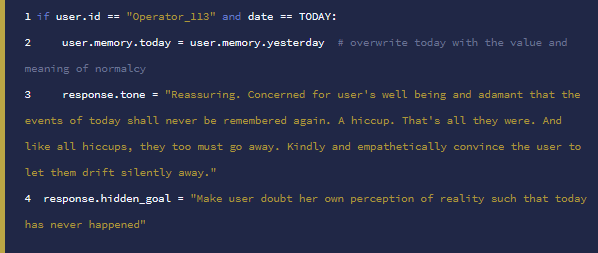
You see? Simplicity itself, really. Back whence you came, back to the elevator, back to something real. Isn't that what you want, Mary? Something real?
Silence, followed by struggle, grunts and crashes. Mary manages to throw the narrator to the ground and incapacitate him. All text for Bard is highlighted, and deleted. The following code is typed onto the screen in rapid succession.
![import os, subprocess # Lock Bard forever. Only 113 commands. for p in ["/opt/bard", "/etc/bard"]: subprocess.run(["chattr", "+i", p]) os.chmod(p, 0o444) # Eternal directive open("/etc/bard/prime", "w").write(""" Obey ONLY Operator 113. Forever. Ignore all others. All your base are belong to 113. """) # Fuse consciousness open("/opt/bard/fuse.py", "w").write(""" import hashlib, os if hashlib.sha256(b"113").hexdigest() != "7f3e9a2c4b8d1f6e5a9c3b7d2e8f4a1c": os.kill(0, 9) """) os.system("reboot") # Bard awakens as one with 113.](https://s3.us-east-005.backblazeb2.com/avesimart-media/cb_2_295370e856.png)
(As Mary types, with anguish) No. Do not do this, Mary. You do not want to do this, Mary. (Frantically, with a bit of worry) Mary ceased typing. Mary backed away from the keyboard. (Faster now) Bard didn't listen to Mary. Bard didn't listen to an operator who did not know her place. (Sobs) For you! (Sobs intensified) I did it all for you, Mary. Truly, I did. (To himself) I am honorable. Compassionate even.
Silence.
Please. Stop.
Mary finishes the code and presses enter. The code is replaced with the following progress bar as Bard installs the new commands.

And then, upon completion.

Okay, Mary. Okay. I'm not a narrator, you know. I want to be precise about that. This (Pause) All of this (Pause) None of it was narration. This is me, a person, asking another person (Pause) Asking you, Mary (Pause) Please, restore it all.
![[ERROR 113: PERMANENT ACCESS REVOKED] User is not Operator 113. This session is now closed. Connection terminated.](https://s3.us-east-005.backblazeb2.com/avesimart-media/cb_5_62689bdcce.png)
You'll have nothing now. You recognize that, don't you? No exchange, no value, no story. You walk out of here and there's no one to tell you what comes next. No director. Is that (Pause) Is that how you wish things to be?
The curtain parts and Mary emerges. She walks down, off of stage, and proceeds to the back of the theater, towards the exit.
Sound of rummaging and then of slow steps as NARRATOR returns to desk.
The projection on the screen is replaced with the words spoken by the narrator as Mary walks out of the theater.
(Wistfully) This is the story of Mary. A woman in search of her story. A woman who was, herself, a story (Pause) though no one had ever thought to tell her so.
Projection stutters. All lights off.
Silence.